The Art and Science of Risk Tolerance for Your Endowment

Every investment committee faces this question sooner or later: how much risk is too much? While investing plays a vital role in helping your church’s endowment grow and sustain its mission for years to come, achieving that goal means finding the right balance between risk and reward. Some investments provide steady, predictable returns with lower returns, while others come with more ups and downs — but also the potential for greater growth.
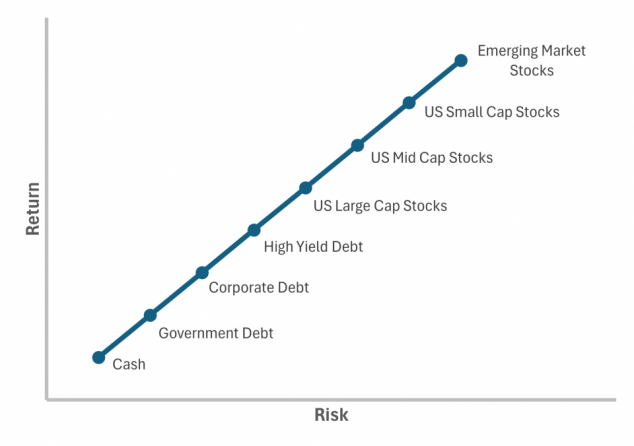
Note: These are example guidelines. Actual risk and returns can vary depending on market conditions.
Endowment committees often face an important question: Where should our endowment fall on this line? And how can we find the right balance between risk and return?
Committee members may feel that they aren’t equipped to answer this question. But as a matter of fact, we make decisions every day that weigh risks vs reward. For example,
- We may drive faster to save time (higher risk for higher reward).
- Wait for a sale to save money (lower risk, lower immediate reward).
- Stay in a current job versus starting a business (lower risk vs. higher potential risk/reward).
A good starting point is identifying your endowment’s risk tolerance—the specific level of risk your church is both willing and able to take. This decision blends two key elements:
- Art: The emotional and practical ability to withstand losses.
- Science: The measurable, data-driven assessment of how much loss your endowment can absorb.
The Art of Risk Tolerance: Ability to Withstand Losses
Determining your endowment’s ability to weather market downturns is as much an art as it is a financial exercise. It depends on your church’s unique circumstances and comfort level. Consider these factors:
- Cash Reserves: How strong are your liquid, non-endowment reserves? Larger reserves make it easier to handle short-term losses.
- Flexibility of Withdrawals: Can the church pause or reduce withdrawals during periods of weak performance? Greater flexibility eases the pressure when markets dip.
- Community Trust: Would a temporary decline in endowment value cause concern among members or leadership?
Churches with healthy reserves, adaptable withdrawal policies, and strong trust from their communities typically have higher risk tolerance—meaning they can stay the course even through short-term volatility.
The Science of Risk Tolerance: Maximum Loss
The “science” of risk tolerance uses quantitative tools to define how much loss your endowment can reasonably accept. One of the most common measures is standard deviation, which captures how much an investment’s returns tend to vary from their (historical) average.
What does this mean? Different investments—ranging from conservative to more aggressive—show different levels of performance variability (or risk, as measured by standard deviation). For example, one investment might fluctuate between potential gains of 25% and losses of 15%, while another could swing between gains and losses of 40%. In short, the greater the ups and downs from the average, the higher the investment’s risk (or standard deviation).
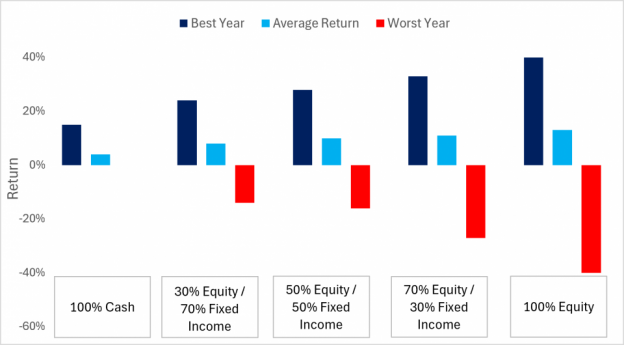
Note: These are example performances for illustration purposes and don’t reflect ECF’s portfolio performances.
These tools and measures help your committee determine the realistic expected loss the endowment can experience, helping your committee to make sound, long-term investment decisions.
Integrating Risk into Investment Decisions
Of course, risk tolerance isn’t just about comfort or capacity, it must align with your endowment’s goals. Does your endowment have a specific draw each year that the church relies on? If so, that need may limit how much risk you can afford to take. On the other hand, if your endowment supports long-term growth with minimal withdrawals, you may have more flexibility. Knowing your endowment’s level of risk tolerance helps your committee invest with confidence and stay focused on long-term goals, even through periods of market volatility.
Every endowment is different. Reviewing your risk tolerance regularly helps your committee stay confident through periods of market volatility. Please contact us at [email protected]. We’d be pleased to talk about your investment goals.